Generative AI · digital trust · 10 min read
This photo was never taken.
When creation is no longer the problem, proving becomes one.
The experiment
Same person.
Two origins.
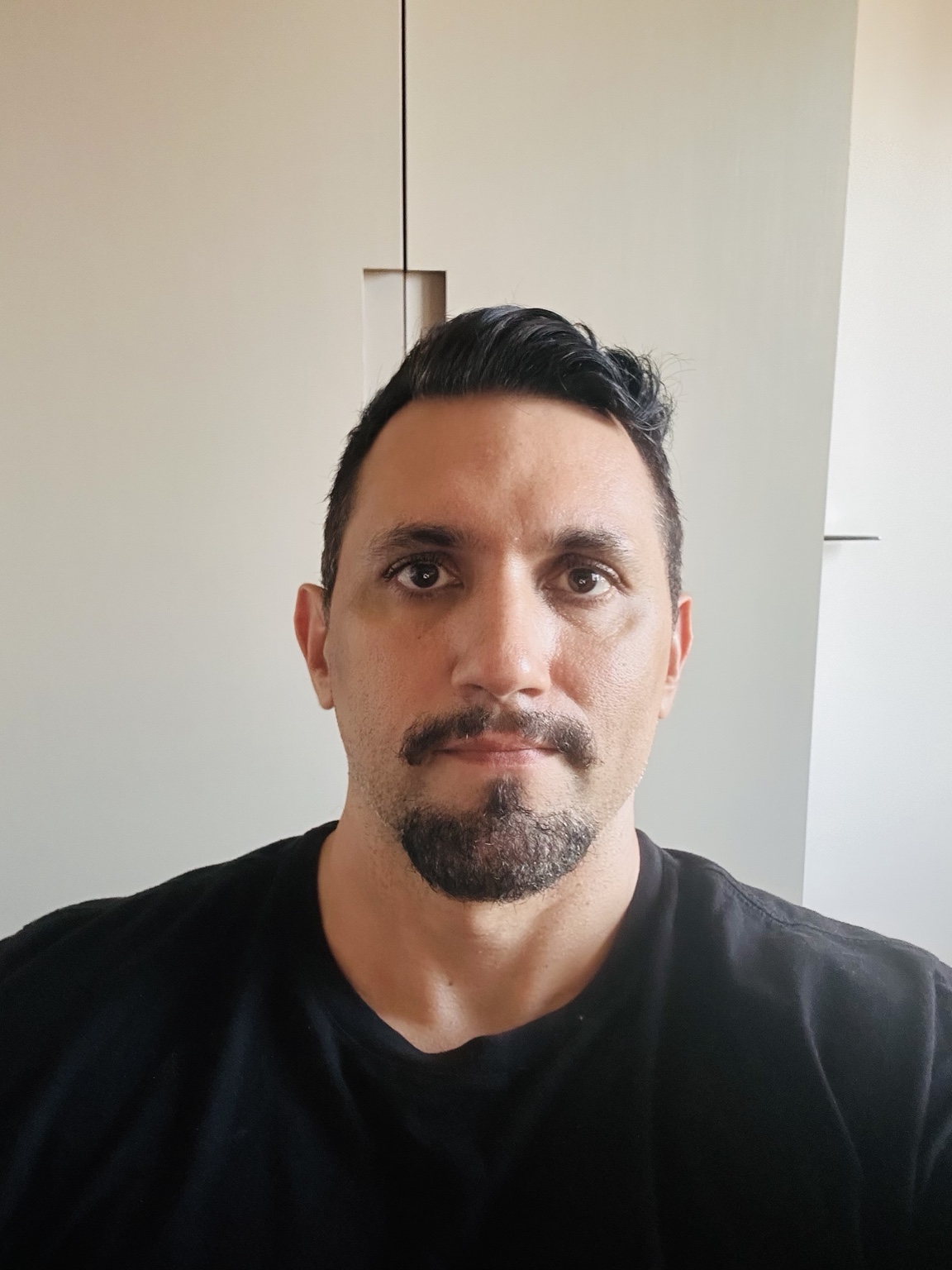
Smartphone · natural light · at home
 AI-generated
An image that was never photographed
The face, hair, and beard are recognizable. The shirt, lighting, setting, and camera never existed together in this combination.
Today I took a photo at home: black t-shirt, wall behind me, natural light, and a smartphone. A short time later, I had another image — professional, carefully lit, in a corporate setting.
There is only one detail: this photo was never taken.
What has changed is not just the quality of generation. AI is changing the economics of the process: it lowers the cost of turning an idea into something convincing, and the cost of trying again.
From a full cycle to create and launch a new asset to the ability to develop and test variations in under an hour.
The economics of trying
The impact is not only creating faster.
A traditional production can involve a photographer, studio, lighting, wardrobe, travel, selection, retouching, and delivery. In the experiment above, the path was different: smartphone, photograph, prompt, iteration, and result.
The key point may not be the cost of one image. It is being able to try: change wardrobe, backdrop, framing, and creative direction without every hypothesis needing a new production.
When creation gets cheaper, companies stop asking “which image should we make?” and start asking “which ideas should we test?”
Reported cases
When more variations become economically possible.
Amazon Ads · Hisense Mexico + EPA
Seven variations per product, where there used to be one or two.
Amazon Ads · Oneisall
Creative scale across products, countries, and seasonal campaigns.
These are commercial case-study results, not a guarantee that AI alone creates the same outcome. The relevant operational signal is that more hypotheses can be tested.
The other side
Creation becomes cheap.
Trust becomes expensive.
Seeing was never perfect proof. But producing a convincing forgery used to require knowledge, tools, and time. Generative AI lowers all of those barriers at once.
That is why the next challenge may not be detecting whether something “looks like AI.” It is answering: can I verify where this content came from?
That is the difference between detection and provenance. C2PA, Content Credentials, and watermarking mechanisms create a new layer of trust: not to claim that the represented world happened exactly as shown, but to make an asset's origin and history verifiable.
What comes next
A new layer of engineering?
The easier it becomes to create convincing synthetic content, the greater the need may become to build systems that establish trust in where it came from.
When we think about this problem, the first solution we usually imagine is an “AI detector”: a system that receives an image and tries to determine whether it was produced by a generative model. But that may not be the most important long-term approach.
Can I detect whether this was made by AI?
Can I prove where it came from?
As models evolve, distinguishing synthetic content by looking only at the result is likely to become increasingly complex. This shift from detection to provenance can create new engineering problems — and, consequently, new specializations.
We may see people working specifically with digital provenance, content authenticity, synthetic media forensics, watermarking, and AI trust systems. The names of these professions may still change. The need probably will not.
Engineers may build systems responsible for:
- cryptographic signatures and credentials;
- integrating standards such as C2PA;
- watermarking and chains of trust;
- origin verification and synthetic-media forensics;
- anti-fraud systems, provenance APIs, and trust policies for digital platforms.
AI does not eliminate engineering. It changes the problems worth solving.
This image is representative, but not documentary. It does not record a moment that happened; it shows a plausible version of me in a setting that never existed.
We may need a better vocabulary for the difference between creating, transforming, manipulating, and manufacturing evidence. When anyone can create almost anything, proving where something came from may become one of the internet's most valuable capabilities.
Sources & references